Sports Bra Fitting Guide
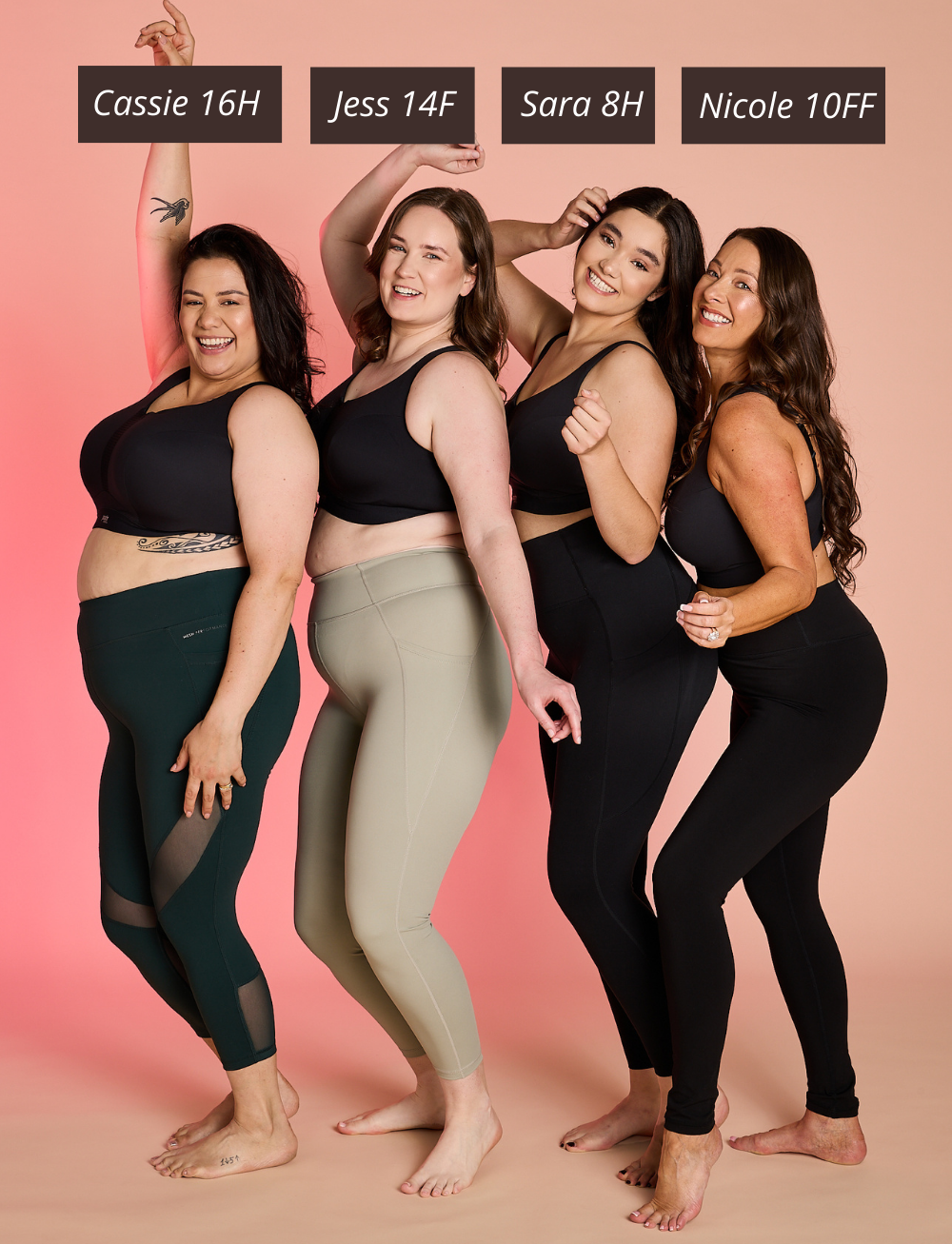
Finding the right sports bra can be challenging in bigger cup sizes. It's important to find the most suitable one for your body shape. Some bra manufacturers have endless marketing dollars to convey how effective their sports bras are, but in our experience, just like any bra, a sports bra can work very differently with different bodies. If you'd like expert advice, our fitters can help — book an in-store fitting, try ZoomFit over video, or submit the Virtual Fitter form.

What to expect from a sports bra
A good sports bra will minimise the bounce, however you can't expect it to completely stop the bounce. To do this, your sports bra would need to be so tight it completely compresses your bust against your chest wall, which would result in restricted breathing. However you should feel comfortable and supported.
As with many products you get what you pay for; however if you are participating in low-impact activities, you can achieve a good result for lower cost as the bra does not need to be as structured. If you are a D cup or above and participate in high impact activities, then you will benefit from wearing a high quality, well-structured sports bra.
The reality about breast sag
While sports bras do give breasts support, they do not ultimately prevent breasts from sagging. Gravity will eventually take its effect, we change because of the proportion of fat and tissue in our breasts, and no bra changes that. Sports bras provide support for the breasts while we are wearing them and can prevent further sagging.
It helps when women accept how normal it is to change shape because when we get so brainwashed by the media images of young perky breasts, we no longer know what is normal. In reality it is perfectly normal for adult breasts to be hanging in a lower, relaxed position.
The short version: a sports bra minimises bounce and prevents further sagging while you're wearing it, but no bra reverses gravity. Choose support and comfort, not the look.
How to get the right fit
| Check | What to look for |
|---|---|
| Too small | Scoop your breasts in the cups so they are centred and level. They should be completely held within the cups. Breast tissue that comes out the top or side indicates the cup is too small. |
| Too big | The fabric in the cups should be smooth. Wrinkles or puckers indicate the cup is too big and you will need to go down one cup. |
| Too loose | The band should fit more snug than a standard bra and lay horizontal across your back without riding up. If it rides up, the band may be too loose. Make sure you can comfortably take a deep breath with the bra fastened on the loosest adjustment. |
| Need a larger cup | The underwire should sit on your ribcage below the breast tissue — it shouldn't poke or pinch. The centre panel should lay flat against your breastbone. If it doesn't, you may need a larger cup. |
Which sports bra style is best for you?
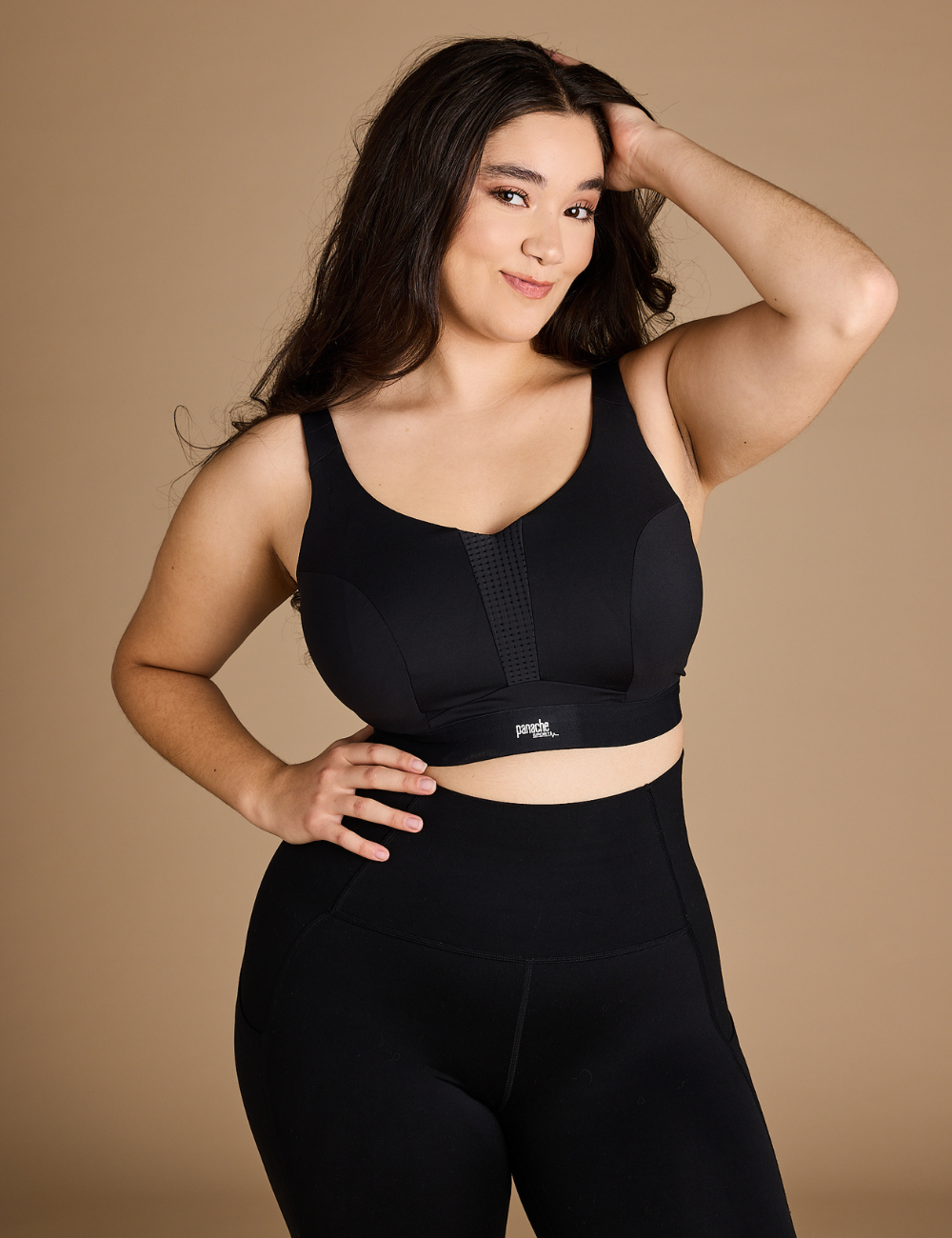
We have chosen not to offer a low-impact sports bra simply because if you have a larger bust, you need all the support you can get. Brava offers a great collection of sports bras for all high impact sports.
| Style | How it works | Best for |
|---|---|---|
| Encapsulation | A full-coverage design that separates your bust, with each breast encapsulated inside its own cup rather than being compressed | Usually more comfortable for larger-breasted women; studies show it's better at reducing breast movement |
| Compression | Keeps breast motion to a minimum by pressing the breasts firmly to the chest | Women who prefer a flatter projection and minimal movement |

Brava's top tips
- The bounce test. With each sports bra you try, do the bounce test by jumping up and down, swing your arms and move around. If a bra pokes, constricts your breathing, or bulges, it's not right for you.
- Adjustability. It should fit on the first hook; as it loses elasticity over time, you'll need room to tighten it.
- Add a crop. Although a sports bra alone should provide enough support, research shows that a crop top over the top can add another 15% more support.
- Go for a full cup. The most supportive sports bras are usually full in the cup. With a sports bra, choose support, not the look.
- No need for discomfort. Don't buy it if it's uncomfortable, because the comfort level will remain the same when you get home.
Find the right sports bra
The fastest way to a sports bra that actually fits is having an expert fitter put eyes on you. Brava fittings come with no obligation to buy.
- Book an in-store fitting at Brava HQ Moorabbin (Melbourne) or our Sydney boutique.
- Try ZoomFit — a private one-on-one fitting via video call from anywhere in Australia.
- Submit the Virtual Fitter form for personalised size and style recommendations by email within 24–48 hours.
Or browse our full sports bra collection online — we stock D through K cup, in band sizes 8–22.
Common questions
Why do I need to wear a sports bra?
Wearing a sports bra is beneficial, regardless of what age you are. Sports bras reduce breast bouncing while running or doing other types of active sports. Bouncing during jogging, for example, can actually damage the ligaments inside the breasts. There is no muscle in the breast and if your breasts are not supported with a good sports bra during exercise they will bounce, stretching the tendons, causing breast sag. This is irreversible.
Even for a low-impact activity such as walking or yoga, it is important that you are supported, and also comfortable to give you the ability to move freely.
It's important to find the most suitable sports bra for your body shape. There is an assortment of wired, wirefree, encapsulation and compression sports bras, often with enticing features such as crossbacks and ipod holders, however nothing is more important than the actual comfort and support.
Can the right sports bra prevent pain?
The biggest pain relief can come from changing poor posture. A woman who is overly conscious of her bust size or shape will often hunch to make the bust less obvious, which can result in shoulder tendonitis, aching neck and headache. Get the breasts up where they belong, roll your shoulders back and down, hold your head high and you'll have less pain.
Wearing the right sports bra can also prevent chafing and indents.
When should I replace my sports bra?
If you wear your sports bra 3–4 times per week you will need to replace it within 6–12 months. Your sports bra needs to be washed after each wear as sweat, body heat and body oils break down the elasticity. Replace your sports bra when you notice that your breasts start having a wider range of motion or it has a noticeably looser fit.
Ready to find your perfect fit?
Brava's expert fitters can help. Choose what works best for you.
In-store fitting
Book online at Brava HQ Moorabbin (appointment only) or our Sydney boutique. Walk-in fittings welcome at our other stores.
Book in-store →ZoomFit
A private, one-on-one bra fitting via video call from anywhere in Australia.
Book ZoomFit →Virtual Fitter
Submit photos and details — we’ll email personalised size and style recommendations within 24–72 hours.
Try Virtual Fitter →